
NGO for Children: How Shoishob Nurtures 400+ Young Lives in Kolkata

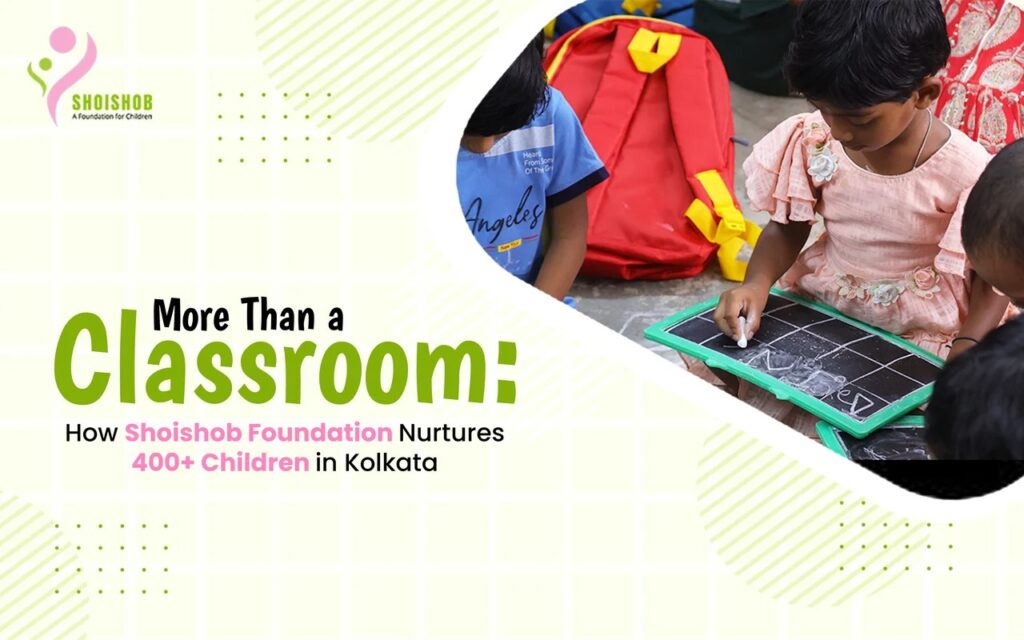
A child who sits through a lesson on an empty stomach doesn’t absorb much of it. A child with an untreated fever misses a week of school, falls behind, and slowly stops coming at all. Anyone who has worked with families in Kolkata’s low-income neighbourhoods has watched this chain play out. One unmet need drags the others down with it.
That observation sits at the heart of Shoishob – A Foundation for Children. Since 11 August 2021, the foundation has supported more than 400 children, and it has never treated education as a stand-alone service. Classes, meals, healthcare and cultural activities run together, because a child grows in all of these directions at once. This is how an NGO for children can make a meaningful difference by looking at the whole child instead of one problem at a time.
Why one kind of help is never enough
Support that covers a single need tends to leak. Here’s what a child from a struggling household usually faces all at once:
- Hunger: a child who hasn’t eaten loses focus by mid-morning and has little energy left for play.
- Poor health: minor illnesses go unchecked and quietly turn into long absences.
- Limited exposure: without art, music or movement, a child rarely finds out what they’re good at.
- A digital gap: classmates from better-off homes already know their way around a computer.
This is why an NGO for children must focus on more than just education. Addressing nutrition, healthcare, emotional well-being and skill development together creates a stronger foundation for a child’s future.
Shoishob’s belief is plain: “We can’t help everyone, but everyone can help someone.” So the foundation stays close to a defined group of children and looks after each of them fully, rather than spreading thin across a city this size.
Why this matters in Kolkata
Kolkata is a city of contrasts. Glass-fronted offices sit a short ride from lanes where families count every day as it comes. Children growing up in those lanes are rarely short of potential. They’re short of steady support at the right moment. An NGO for children works in exactly that gap, and it has to do more than open a classroom door. It has to make sure the child can walk through it fed, healthy and ready to stay.
Education that reaches past the textbook
Education is where the work begins, but it doesn’t end at the blackboard.
- Quality education: structured teaching that helps children keep pace with their age group and stay enrolled year after year, ensuring access to quality education for every child
- Computer literacy: basic computer skills, so the tools children will meet in college and at work don’t feel foreign.
- Skill development: practical abilities that give older children something to build on when school ends.
As an NGO for children, Shoishob believes that learning should go beyond textbooks. By combining classroom education with computer literacy and practical skills, the foundation helps children develop confidence and prepare for future opportunities.
Lessons stick when a child is fed, healthy and curious. That’s why teaching sits at the centre of the programme without being the whole of it. A child who keeps up in class feels it too: hands go up more often, homework gets finished, and school starts to feel like a place that belongs to them.
Nutritious meals: the quiet foundation
Nobody writes headlines about lunch, yet it may be the most practical thing a foundation can give a child.
- Nutritious meals keep energy steady through a full day of lessons and activities.
- A child who eats well concentrates longer, asks more questions and finishes more of what they start.
- Eating together gives the day a rhythm, and friendships form faster around a shared plate.
- Families worry less about the next meal, which leaves room to think about the child’s schooling.
- A regular balanced meal also teaches children what good eating looks like, a habit that outlasts childhood.
For an NGO for children like Shoishob, providing nutritious meals is not simply about addressing hunger. It is about helping every child feel healthier, more energetic and ready to participate in daily learning activities.
Healthcare that catches problems early
- Regular attention to health means small issues get noticed before they turn into weeks of missed school.
- Healthy children attend more often, so each lesson builds on the last one instead of starting over.
- Hygiene programmes teach everyday habits that children carry back home to their families.
- Children who feel physically well are more willing to run, play and take part, which is where much of their social growth happens.
A sick child can’t learn, and a worried family can’t focus on school. Looking after health removes both problems before they grow.
Cultural activities: where children find their voice
A child who can’t read well yet can still sing, draw, dance or tell a story. Cultural activities give children a place to be good at something early, and that first taste of confidence carries into the classroom.
- Creative expression builds self-belief, especially for children who struggle with exams.
- Group activities teach teamwork, patience and turn-taking without a lecture.
- Celebrating the festivals and traditions of Bengal keeps children connected to their roots and to each other.
A quiet child who has performed in front of friends often speaks up in class a little sooner.
How the pieces work together
Picture an ordinary school day. A child arrives, eats a proper meal, sits through class, spends time on a computer and joins an afternoon activity. Take away any one of these and the rest weaken. Without the meal, the class suffers. Without good health, attendance suffers. Without the creative hour, motivation suffers. As an NGO for children, Shoishob keeps all of them in place at once, and that gives 400+ children a steadier chance at growing up well.
Women's independence: the other half of the picture
Children do better when the adults around them feel secure. Alongside its work with children, the foundation runs:
- Tailoring classes that teach a skill women can turn into steady work.
- Financial empowerment initiatives that build confidence in handling money.
- Hygiene programmes that bring health awareness into the household.
A mother with her own income can keep a child in school through a hard year. That’s why a NGO for children in Kolkata that cares about children also has to care about the women raising them.
What makes this approach worth backing
- It treats a child as a whole person, not a single problem to fix.
- It stays focused on 400+ children, so attention doesn’t thin out.
- It links a child’s growth to the family’s stability through its work with women.
- It rests on one clear belief that anyone can act on, whatever their resources.
What to look for before you back an organisation
If you’re a parent, a volunteer or a business thinking about supporting children’s work, a few questions are worth asking.
- Does it look at the whole child, or at one need only?
- Does it know how many children it serves, and can it say so plainly?
- Does it involve the family, especially the mothers?
- Can you visit, ask questions and see the work for yourself?
Shoishob’s answer to the first question is built into how it works: education, meals, healthcare and cultural activities run together for the same 400+ children.
About Shoishob – A Foundation for Children
Established on 11 August 2021, Shoishob works under the tagline “Where Little Dreams Take Root”. It supports more than 400 children with quality education, nutritious meals, healthcare, cultural activities, computer literacy and skill development, and it supports women through tailoring classes, financial empowerment initiatives and hygiene programmes. As NGO for children in Kolkata, Shoishob Foundation for Children measures its work in children who stay in school, stay healthy and start believing in themselves.
Looking for an NGO for children to stand behind? Visit shoishobfoundation.com to read about the programmes and find a way to take part. You can volunteer your time, share the foundation’s work with your circle, or reach out to ask how your skills could help. Everyone can help someone, and Shoishob Foundation for Children can show you where to begin.

Frequently Asked Questions
Q1. What does Shoishob do?
Shoishob Foundation for Children supports 400+ children in Kolkata through education, meals, healthcare and cultural activities. It was established in August 2021.
Q2. Which services does the foundation offer children?
Quality education, nutritious meals, healthcare, cultural activities, computer literacy and skill development. Together they cover a child’s learning, health and confidence.
Q3. Does Shoishob also work with women?
Yes. It runs tailoring classes, financial empowerment initiatives and hygiene programmes. A more secure household helps a child stay in school.
Q4. How is this different from a regular tuition programme?
Tuition covers lessons alone. Shoishob adds meals, healthcare and cultural activities, so a child is ready to learn and not just present in class.
Q5. How can I support the foundation?
You can volunteer, share its work or get in touch through shoishobfoundation.com. Time and skills count as much as anything else.
Join us in creating opportunities, restoring dignity, and building brighter futures for children and families in need.
Shoishob Foundation is a trusted NGO in Kolkata and a dedicated child welfare organisation, empowering underprivileged children and women through education, cultural development, healthcare, and livelihood initiatives to create brighter, more dignified futures.
/* Background Overlay */
background-color: rgba(0, 0, 0, 0.75); /* Dark semi-transparent background */
/* Active State */
/* Popup Container (Fully Responsive) */
max-width: 500px; /* Laptop / Desktop width */
width: 100%; /* Mobile responsive */
max-height: 90vh; /* Height overflow control for small screens */
/* Popup Image */
max-height: 85vh; /* Screen se bahar nahi jayegi */
/* Cross (Close) Button */
background-color: #dc2626; /* Eye-catching red color */
/* Mobile screens ke liye adjust close button */
// 1 Second (1000ms) baad turant open karne ke liye
// Close Button click event
// Background Overlay click karne par close hoga





-
Head Office:
308 Dr B C Roy Sarani, Masunda West, New Barrackpur, Kolkata - 700131 -
Branch Office:
15A/6, Khanpur Rd, Naktala, Netaji Nagar, Naktala, Kolkata - 700047 - info@shoishobfoundation.com
- +91 84209 72430
Copyright © 2026 Shoishob Foundation. All Rights Reserved. Crafted with ❤️ by Aspire Digital Media